

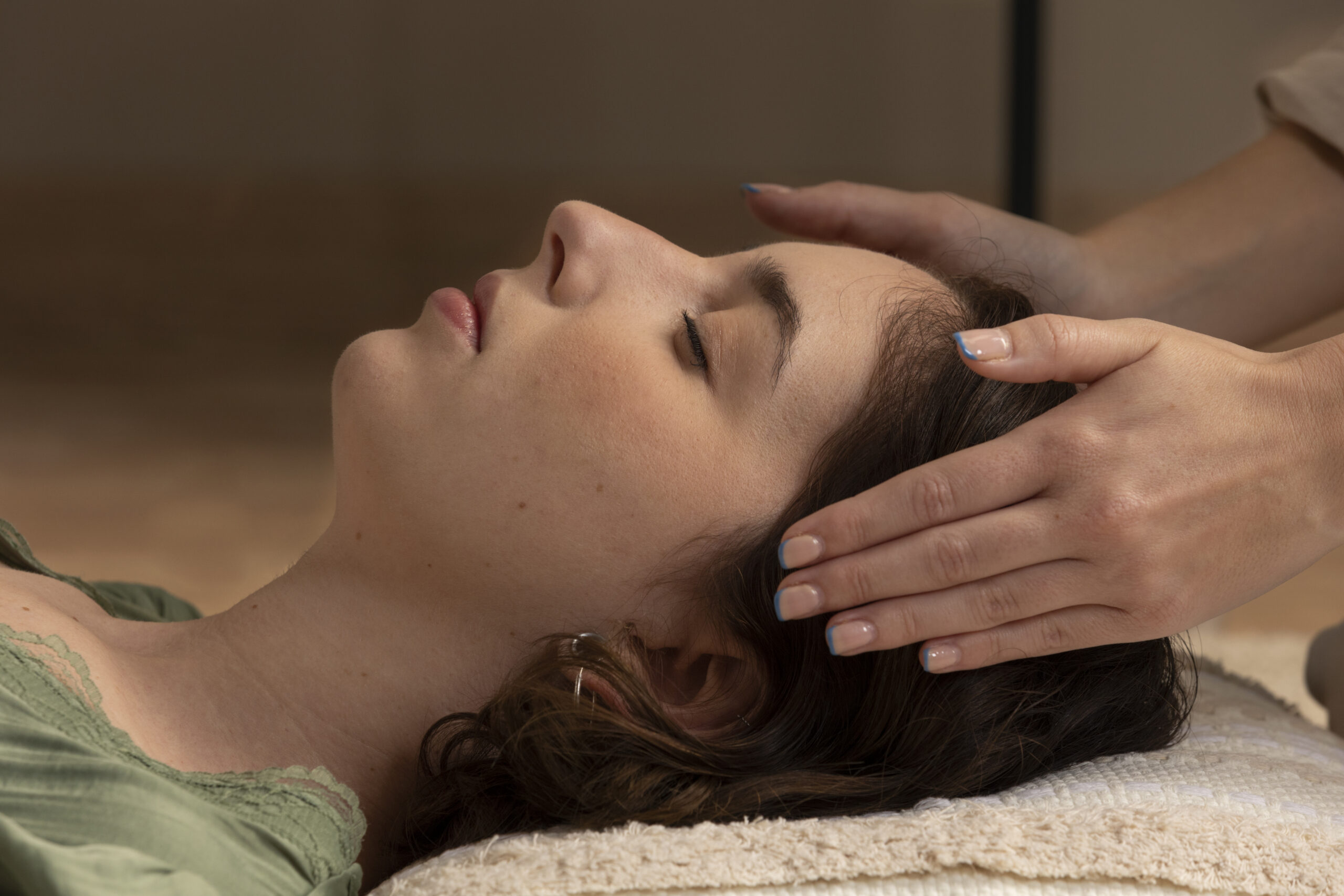
Image by Magnific
You’ve probably heard the word before. Maybe at a spa, a yoga studio, or from a friend who swears by it.
But if you’ve ever wondered what reiki actually is, what happens during a session, or whether it might be right for you, this is a good place to start.
A lot of people are curious about reiki and not quite sure what to make of it. That’s fair. Here’s an honest, grounded look at what it is and how it works.
Where Reiki Comes From
Reiki was developed in Japan in the early 1920s by Mikao Usui, a Buddhist lay monk who formalized the practice following an intensive period of meditation and fasting on Mount Kurama, a sacred site outside Kyoto.
The word combines two Japanese characters: rei, meaning universal or spiritual, and ki, meaning life force energy. Ki is the Japanese equivalent of qi in Traditional Chinese Medicine. It’s the animating energy that flows through the body and underpins practices like acupuncture, qigong, and tai chi.
The idea is straightforward. When ki flows freely, the body has what it needs to regulate, repair, and heal. When it becomes blocked or depleted through injury, chronic stress, unprocessed emotion, or accumulated tension, the body’s natural balance is disrupted. Reiki works to restore that flow.
From Japan, the practice spread worldwide throughout the 20th century. Today it’s offered at hundreds of hospitals in the United States, including major cancer centers and palliative care programs. It has moved firmly into the mainstream of integrative medicine.
What Actually Happens in a Reiki Session
Reiki sessions are simple, non-invasive, and deeply restful. You stay fully clothed and lie on a treatment table while the practitioner places their hands lightly on or just above specific areas of your body. The practitioner moves through the body systematically, spending several minutes at each area. Each position is held for several minutes.
There are no needles, no manipulation, no required belief. The practitioner channels and guides energy to areas where flow has been disrupted. Sessions typically run 60 to 90 minutes. If that sounds abstract, you’re not alone. Most people arrive with questions and leave with a felt sense that’s harder to explain than to experience.
Reiki can also be delivered as distant healing, a lesser-known but long-practiced aspect of the tradition that doesn’t require you to be in the same room as your practitioner.

Image by Magnific
What Does Reiki Feel Like?
This is one of the most commonly searched questions. The honest answer: it varies.
Every client’s experience is unique. Common sensations during a session include:
- Gentle warmth or tingling beneath the practitioner’s hands
- A wave-like sense of calm moving through the body
- Heaviness that gradually softens into deep relaxation
- Emotional clarity or a release of tension you hadn’t noticed you were holding
Some people feel profoundly moved. Others drift into a meditative state or fall asleep entirely. After a session, clients often describe feeling more grounded, lighter, or simply quieter than they have in a while. Improved sleep, reduced anxiety, and a renewed sense of inner clarity are among the most frequently mentioned effects.
If a first session feels subtle, that’s normal. The body often needs a few experiences before it fully relaxes into the process.
What Can Reiki Help With?
Reiki is particularly well suited to supporting the nervous system. It helps shift the body out of sympathetic overdrive and into a parasympathetic state. That’s the physiological space where rest, digestion, immune function, and emotional processing actually happen. That shift has real effects on how you feel.
People commonly seek reiki for:
- Stress relief and anxiety support
- Emotional release and trauma recovery
- Grounding during major life transitions
- Chronic pain or fatigue management
- Support alongside acupuncture, counseling, or cancer treatment
- General energy balancing and well-being
The research base, while still developing, is promising. A 2025 meta-analysis of randomized controlled trials found significant quality-of-life improvements following reiki therapy. Studies in oncology settings have shown meaningful reductions in anxiety, fatigue, and pain. A review of 13 controlled studies found that 8 showed reiki performing better than placebo.
Reiki is a complementary therapy. It works best as part of a broader care approach, not as a standalone cure.
Is Reiki a Religion?
No. Reiki has spiritual roots, but it is not affiliated with any religion, denomination, or belief system. It doesn’t require you to believe in it for it to be effective. Clients from every faith background receive reiki regularly, as do people with no religious background at all.
The only thing required is a willingness to rest and receive.
Reiki and Acupuncture: How They Fit Together
Reiki and acupuncture share the same foundational framework. Both work with the body’s energetic field. Both operate on the understanding that life force energy flows through us and that disruptions in that flow contribute to pain, illness, and imbalance.
Acupuncture uses fine needles at specific points along meridian pathways to restore flow. Reiki uses the practitioner’s hands and intentional presence. Because they operate through the same lens, they often complement each other exceptionally well.
Some patients use reiki as an entry point into energy-based care before moving into acupuncture. Others layer the two together for deeper support during high-stress periods, recovery from illness, or grief.
Dr. Bryn is both a board-certified acupuncturist and a certified Reiki Master, which means she can draw on both modalities and recommend what actually fits where you are. With over 35 years of experience in energy healing, intuitive work, and holistic medicine, she brings a depth of practice that goes well beyond technique. Patients who have tried reiki elsewhere often say a session with Dr. Bryn feels different. That depth of experience shows up in the room.
Experiencing Reiki at Austin Transformational Health
Our reiki sessions are offered in a calm, private, and fully supported environment. Distant healing sessions are also available for those who prefer or require remote care. If you’ve read this far, you’re probably ready to find out what it feels like for yourself.
Distant healing sessions are also available for those who prefer or require remote care.
If you’re curious about whether reiki is right for you, reach out to our team or book directly with Dr. Bryn. There’s no pressure to know exactly what you need. That’s what the first conversation is for.

